
In the AIoT era, the OpenHarmony operating system, with its distributed architecture breaking device boundaries, has become the digital foundation for intelligent interconnection of all things, holding significant importance for the autonomous control of digital infrastructure. Currently, OpenHarmony has achieved leapfrog development with over 1.2 billion ecosystem devices and 10 million developers. At this juncture, talent has become the core variable for the OpenHarmony ecosystem's transition from "scale breakthrough" to "quality leap," and is the fundamental guarantee for resolving technical bottlenecks, activating industrial vitality, and building core competitiveness.
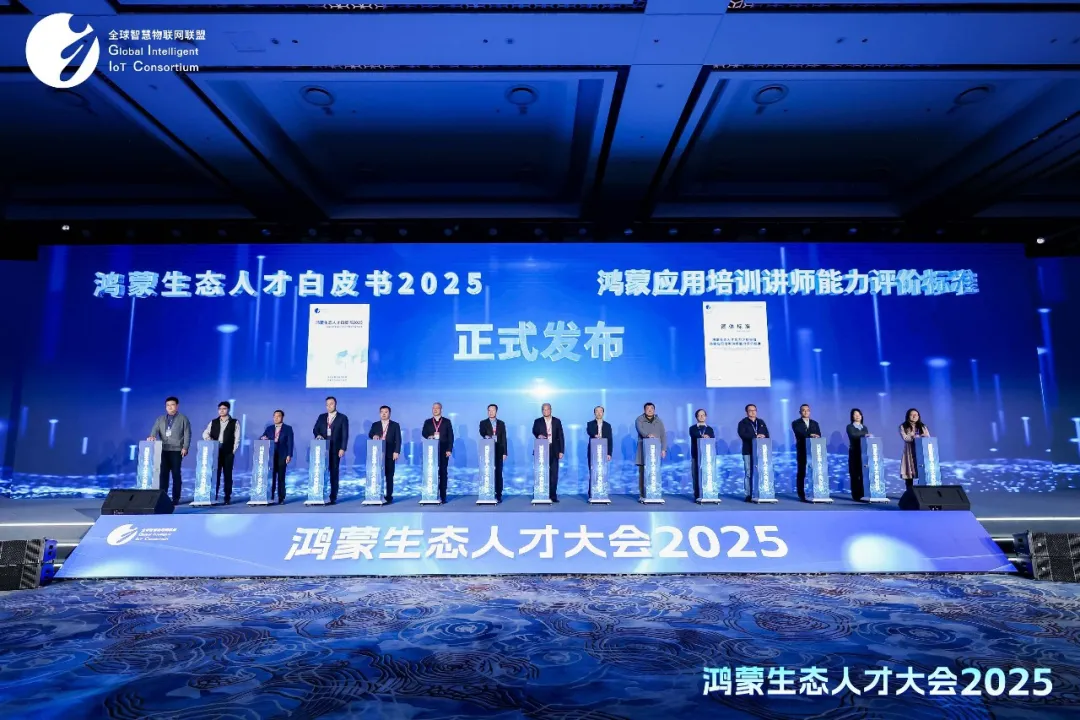
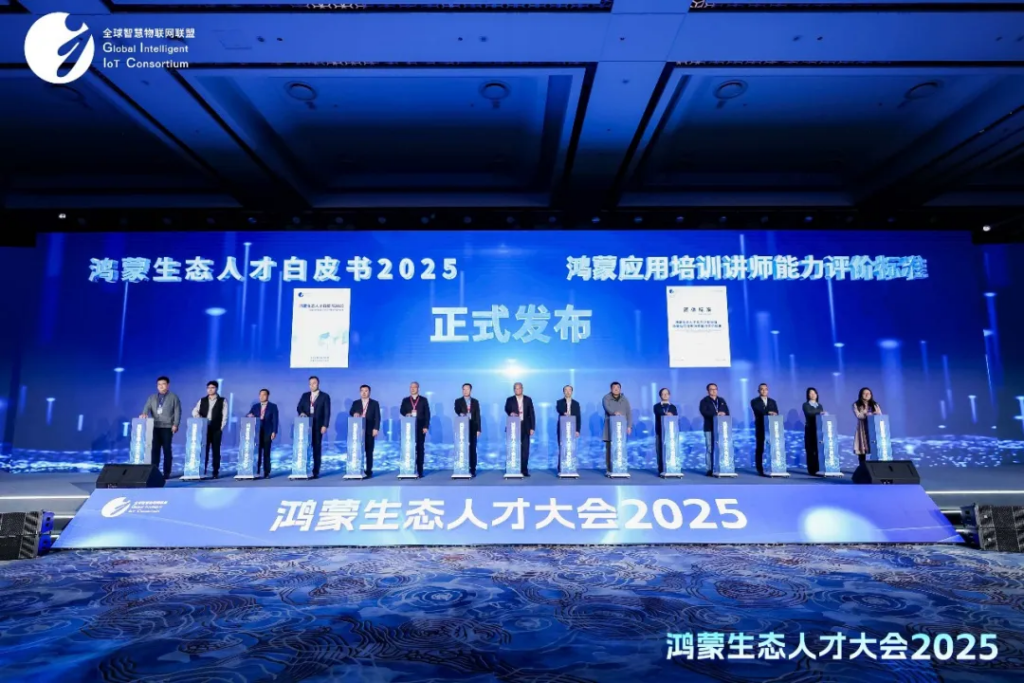
Recently, the Global Intelligent Internet of Things Consortium (GIIC) officially released the *HarmonyOS Ecosystem Talent White Paper 2025* [Follow the GIIC official WeChat account and reply "HarmonyOS Ecosystem Talent White Paper" to access the full report]. Jointly drafted by Huawei Technologies Co., Ltd., HarmonyOS Ecosystem Services (Shenzhen) Co., Ltd., Tsinghua University, Nanjing University, Wuhan University, Shenzhen University, Sichuan Normal University, and other institutions, this white paper aims to present a panoramic view of the supply-demand landscape, competency models, cultivation pathways, and development opportunities for HarmonyOS ecosystem talent. It serves as a strategic reference and action guide for government agencies, universities, enterprises, and developers.
The *HarmonyOS Ecosystem Talent White Paper 2025* provides a comprehensive analysis of the talent landscape within the HarmonyOS ecosystem, highlighting the current imbalance between talent supply and demand. According to the white paper, the ecosystem faces a talent gap of millions, which is expected to generate over 3 million new job opportunities in the future. These demands are primarily concentrated in Northbound application development and Southbound OpenHarmony device development, with 70% of the talent gap stemming from junior and senior development roles, followed by architects and testing professionals.
However, market talent supply has not kept pace with OpenHarmony ecosystem development, resulting in explosive overall demand exhibiting non-linear, exponential growth characteristics. This sharp supply-demand contradiction is directly reflected in the compensation market. Data shows that in 2024, the average salary increase for OpenHarmony developer positions reached 43.1%, with average monthly recruitment salaries approximately 22% higher than comparable technical positions. This significant "salary premium" phenomenon intuitively reflects the current high scarcity and market value of OpenHarmony talent.
In terms of geographic distribution of talent demand, it highly overlaps with China's overall digital economy landscape, with extremely significant agglomeration effects in core hubs. Talent demand is heavily concentrated in the three major regions: Beijing-Tianjin-Hebei, Yangtze River Delta, and Pearl River Delta. However, as local governments increasingly recognize the strategic value of the OpenHarmony ecosystem, talent demand has begun to spread to key second-tier cities with industrial foundations and transformation momentum. Yet, in this diffusion process, the structural mismatch between university talent cultivation layout and regional industrial demands has become increasingly prominent, emerging as a critical bottleneck constraining balanced ecosystem development.
The white paper also highlights the reconstruction of talent profiles, undergoing a profound transformation from relying on "single technology stacks" toward "composite full-stack" capabilities with cross-device, cross-layer, and cross-scenario problem-solving abilities. The job structure presents an "olive shape," with senior developers accounting for the highest proportion. Enterprises urgently need mid-to-high-end talent capable of independently tackling complex technical challenges and leading architectural design. In terms of skill requirements, 78% of enterprises require core developers to master at least two programming languages, with official certification systems becoming an important basis for talent screening. Meanwhile, developers need to address usability needs of special users and possess composite technical capabilities including audio-video codec, graphics rendering optimization, and lightweight AI model deployment. Talent cultivation must shift toward three-dimensional shaping of "technical depth + scenario breadth + user experience sensitivity."
Additionally, the white paper underscores the importance of policy-driven initiatives, with the policy focus shifting from "cultivating developers" to "managing intellectual capital." Inter-city development competition has also transitioned from industrial agglomeration to the construction of intellectual capital ecosystems. Cities such as Shenzhen, Chengdu, and Wuhan have established intellectual capital ecosystems through policies including talent certification subsidies, rewards for open-source contributions, and startup incubation programs, thereby forming differentiated ecological positioning. The agglomeration of intellectual capital is reshaping regional competitiveness, with local government support for industries, practical opportunities, and innovation atmosphere becoming key factors for developers when choosing where to develop their careers.
Faced with current market demands and characteristics, the OpenHarmony ecosystem talent cultivation model differs significantly from traditional technical talent cultivation.
On one hand, as the main front for talent cultivation, universities are undergoing systematic transformation from "introducing a new course" to "reconstructing curriculum systems and innovating education mechanisms." For example, Shanghai University of Engineering Science has explored a "dual-qualification" teaching model, constructing a spiral closed-loop cultivation ecosystem of "theoretical teaching – industrial practice – research feedback," enabling students to enhance practical capabilities through real-world projects.
On the other hand, the integration of industry and education continues to deepen, with enterprises rapidly shifting their talent evaluation criteria from "whether one holds a certificate" to "whether one can deliver in real-world scenarios." Leading companies are partnering with universities to develop "micro-project libraries" and "case workshops" based on genuine business needs, enabling students to engage with and solve engineering problems featuring complex business contexts during their academic years—thereby shortening graduates' adaptation cycle from "knowing the theory" to "creating value." Meanwhile, to address the HarmonyOS migration needs in the B2B general office domain, talent cultivation must rely on more in-depth "industry mentorship programs" and "immersion in real enterprise projects" to meet the "technology + business" composite competency requirements that enterprise-grade systems demand of professionals.
It is evident that HarmonyOS talent development is currently in a golden window defined by the triple forces of "strategic potential, market momentum, and value empowerment." Whether the ecosystem can fully and efficiently translate its immense technical potential and market prospects into sustainable industrial competitiveness and talent prosperity will directly depend on resolving three critical challenges: on the talent supply side, the "dual lag" in curriculum depth and instructors' practical capabilities; on the talent demand side, the disconnect between enterprises' requirements for "immediate combat readiness" and universities' "disciplinary" cultivation approaches; and at the ecosystem collaboration layer, the "breakpoints" and "time lags" among industry, academia, research, and application.
The construction of the HarmonyOS ecosystem is, in essence, a collective expedition centered on digital sovereignty and the future of industry. Its success requires not only technological breakthroughs, but also the clustered rise of talent. Governments, enterprises, universities, and every individual developer are all indispensable participants in this expedition. Only when all parties uphold a long-term philosophy, coordinate strategically, innovate in mechanisms, and act pragmatically—jointly building a healthy talent ecosystem characterized by "government guidance, enterprise leadership, university support, and developer co-creation"—can the historic opportunity of the present be transformed into China's enduring competitiveness in the era of intelligent connectivity for all things.