
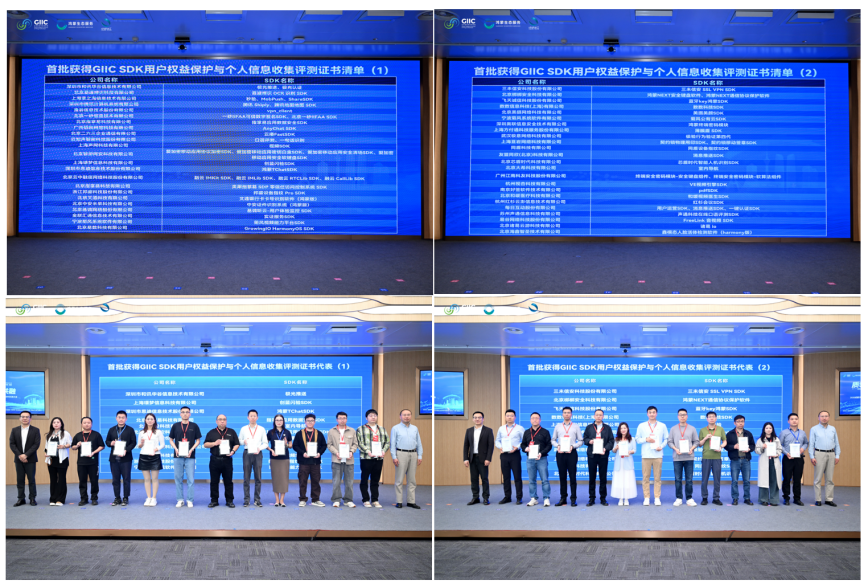
On April 14, 2026, at the "2026 Chengdu HarmonyOS Ecosystem Co-Construction Action and HarmonyOS SDK Exchange Conference" held in Chengdu, the first batch of 64 "GIIC SDK User Rights Protection and Personal Information Collection Evaluation Certificates" issued by the GIIC Consortium was formally presented, with the first batch of 24 partner SDK preferred library entries simultaneously released. This significant achievement marks the HarmonyOS SDK evaluation system's progression from standards construction toward scaled implementation, establishing a solid foundation of security and compliance for high-quality HarmonyOS ecosystem development.

Governance Demands Behind Scaled Growth
As the HarmonyOS ecosystem rapidly expands, SDKs (Software Development Kits), serving as the critical bridge connecting underlying system capabilities with upper-layer application innovation, have simultaneously entered a rapid expansion cycle. Currently, HarmonyOS SDKs cover 21 domains and 64细分 directions, with a total exceeding 1,000, providing developers with abundant system capability invocation interfaces and functional modules.
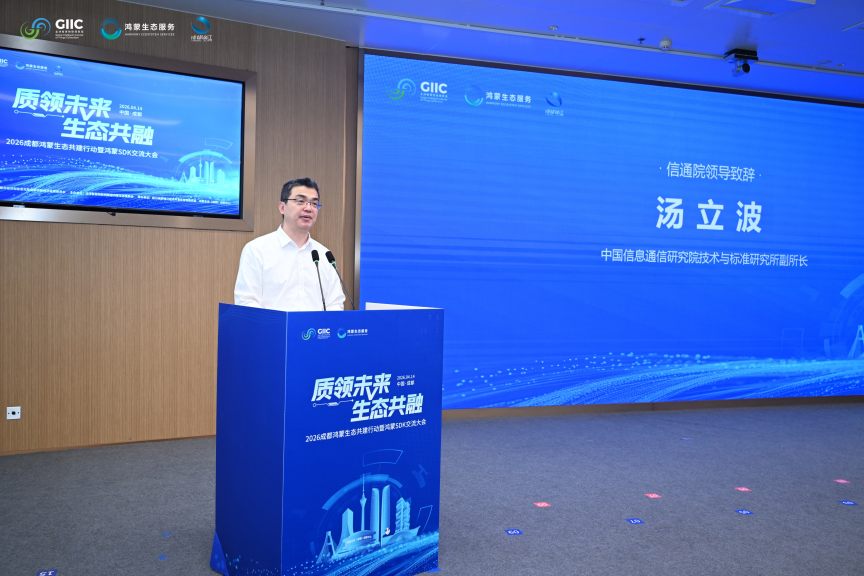
However, accompanying this scaled growth is the lagging pressure on standards, compliance, and governance systems. Mr. Tang Libo, Deputy Director of the Technology and Standards Research Institute of the China Academy of Information and Communications Technology, noted in his conference address that current SDKs still require further standardization in areas such as personal information collection boundaries, authorization mechanism transparency, and capability configuration consistency. Constructing a trustworthy, verifiable SDK evaluation system has become an urgent priority for ecosystem governance.
Authoritative Standards Support, Constructing End-to-End Evaluation System评测体系
This SDK evaluation work relies on two authoritative technical standards released by the GIIC Consortium (Global Intelligent Internet of Things Consortium):
"T/GIIC 0005-2025 HarmonyOS Software Development Kit — Technical Requirements for User Rights Protection and Personal Information Collection"
"T/GIIC 0006-2025 HarmonyOS Software Development Kit — Test Methods for User Rights Protection and Personal Information Collection"
The evaluation employs the "Chongming SDK Detection Tool," conducting systematic assessment of SDKs from core dimensions including business function classification, authorization and consent mechanisms, information collection scope, and privacy configuration capabilities. The Technology and Standards Research Institute of the China Academy of Information and Communications Technology and HarmonyOS Ecosystem Services (Shenzhen) Co., Ltd. have received dual authorization from the GIIC Laboratory and the Chongming Tool, possessing complete qualifications to conduct formal SDK evaluations.
Multiple PartiesContinuously Increasing Investment, Promoting Institutionalized Implementation of Certification System
Mr. Ning Shenglan, Vice President of the GIIC Consortium, noted in his conference address that the HarmonyOS ecosystem has transitioned from rapid popularization to a critical stage of high-quality deep cultivation. As the core hub connecting systems and scenarios, SDKs constitute the solid foundation driving the ecosystem to go deeper and more substantive.
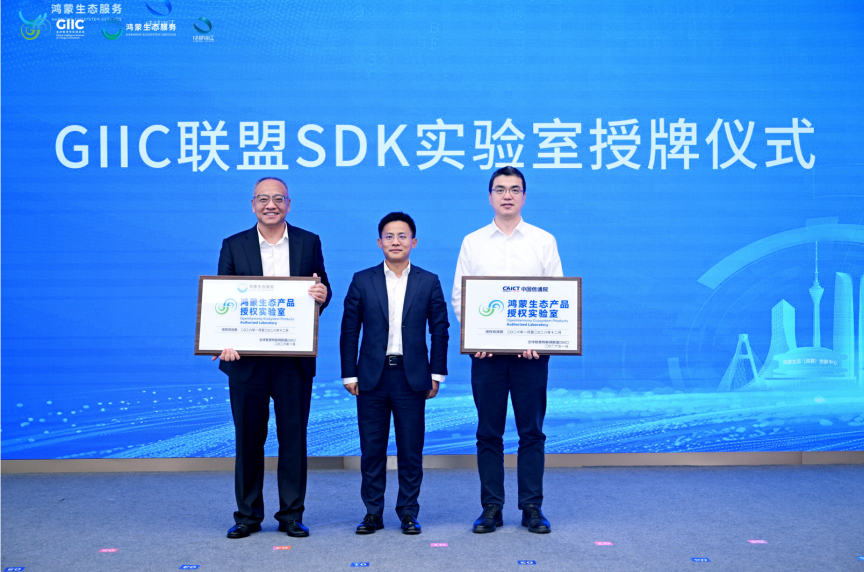
At the GIIC Consortium SDK Laboratory plaque presentation ceremony during this conference, Ning Shenglan respectively presented plaques to the China Academy of Information and Communications Technology and HarmonyOS Ecosystem Services Company. This signifies the further institutionalization and systematization of the HarmonyOS SDK ecosystem synergy mechanism, with SDK evaluation work formally entering the standardized laboratory operation stage, providing SDK providers and application developers with quantifiable, verifiable compliance and quality reference benchmarks.
Notably, during the initial SDK evaluation promotion period, Huawei collaborated with the GIIC Consortium to introduce special support measures, providing testing fee support to leading SDK providers, effectively lowering the threshold for enterprise participation in evaluation, encouraging more ecosystem partners to actively submit for testing, and jointly promoting the HarmonyOS SDK ecosystem toward high-quality, high-standard development.
First Batch of 64 Certificates Issued, Partner SDK Preferred Library Formally Launched
The conference formally issued the first batch of 64 "GIIC SDK User Rights Protection and Personal Information Collection Evaluation Certificates," covering multiple key technical domains including security, communications, and login. Notable SDKs such as Jiguang Push and Tencent Shiply have been among the first to complete evaluation. With GIIC Consortium support, the SDK Standards Group and SDK Certification Group under the HarmonyOS Ecosystem Promotion Committee have cumulatively identified and promoted enterprise corrections and improvements for over 700 issues, encompassing typical problems such as incomplete privacy configuration capabilities and non-standard authorization mechanisms. This evaluation mechanism marks the evolution of HarmonyOS SDK governance from "post-hoc compliance inspection" toward "pre-positioned standardized design."
Concurrently, the conference formally released the first batch of 24 partner SDK preferred library entries. As a critical component of HarmonyOS ecosystem construction, the "HarmonyOS Ecosystem Partner SDK Preferred Library" is dedicated to building a high-standard, comprehensive developer support system. Through integration of high-performance, high-reliability SDK resources, the preferred library assists developers in precisely acquiring quality resources validated through multiple dimensions, efficiently creating innovative HarmonyOS applications.
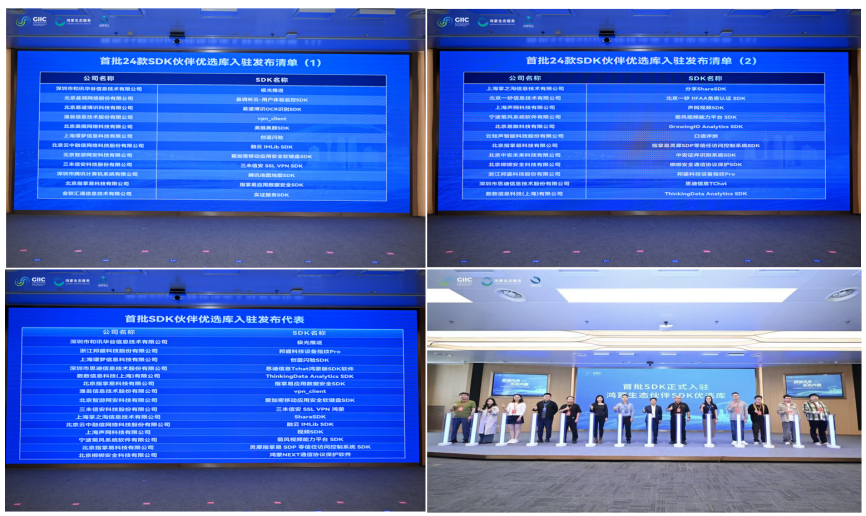
SDKs passing the GIIC evaluation will obtain assessment qualifications for entry into the preferred library. Upon approval, preferred SDKs will receive platform preferred certification标识, enjoying preferred rights to recommended display to developers, with opportunities to reach broader target audiences, jointly building a prosperous and robust HarmonyOS ecosystem.
One Certificate, Three Wins: Ecosystem, Developers, and SDK Providers Mutually Benefiting
This certification certificate holds substantive value for all participants in the ecosystem chain.
For the HarmonyOS ecosystem, unified evaluation standards ensure security consistency in SDK behavior, effectively enhancing overall user trust in the HarmonyOS platform, providing institutional safeguards for ecosystem health and prosperity.
For SDK providers, passing the evaluation signifies systematic compliance verification by authoritative laboratories, effectively reducing their own risks, obtaining authoritative endorsement from the GIIC Consortium, and priority selection for the partner SDK preferred library, establishing differentiated market trust advantages among over 1,000 SDKs.
For application developers, SDKs passing evaluation in the preferred library provide trustworthy selection basis, reducing application delisting risks and compliance costs resulting from introducing non-compliant SDKs, ensuring every integration decision is traceable and verifiable.
How to Participate: Submission Pathways and Participation Methods
For HarmonyOS ecosystem SDK providers, the GIIC Consortium certification service platform (online application, certificate公示, information aggregation) is accelerating construction. Currently, over 200 SDK testing applications have been accepted, welcoming more ecosystem partners to actively participate.
Submission follows three steps:
Step One, prepare materials: organize SDK basic information, HAR package files and interface documentation, and privacy compliance-related explanations;
Step Two, submit application: submit online through the GIIC Consortium certification service platform, or contact the GIIC Consortium to obtain submission guidelines;
Step Three, cooperate with testing: the evaluation laboratory completes full technical testing, and upon completion of any required corrections, the evaluation certificate is issued, with simultaneous obtainment of assessment qualifications for entry into the SDK preferred library.
Outlook
As the standards system continues to improve, laboratory mechanisms accelerate implementation, and ecosystem partners broadly participate, HarmonyOS SDK governance is evolving from a single evaluation system toward an integrated direction of "standards formulation — laboratory verification — ecosystem co-construction." The next stage of HarmonyOS ecosystem development is not merely the incremental growth in application quantity and device scale, but rather the standardization of the standards system, the synergy of governance capabilities, and the symbiotic maturity of the developer ecosystem.
Quality Leading the Future, Ecosystem Integration. HarmonyOS SDK Evaluation — Ensuring Every HarmonyOS Software Development Tool Kit Withstands Scrutiny.
Global Intelligent Internet of Things Consortium (GIIC) HarmonyOS Ecosystem Promotion Committee
April 21, 2026