
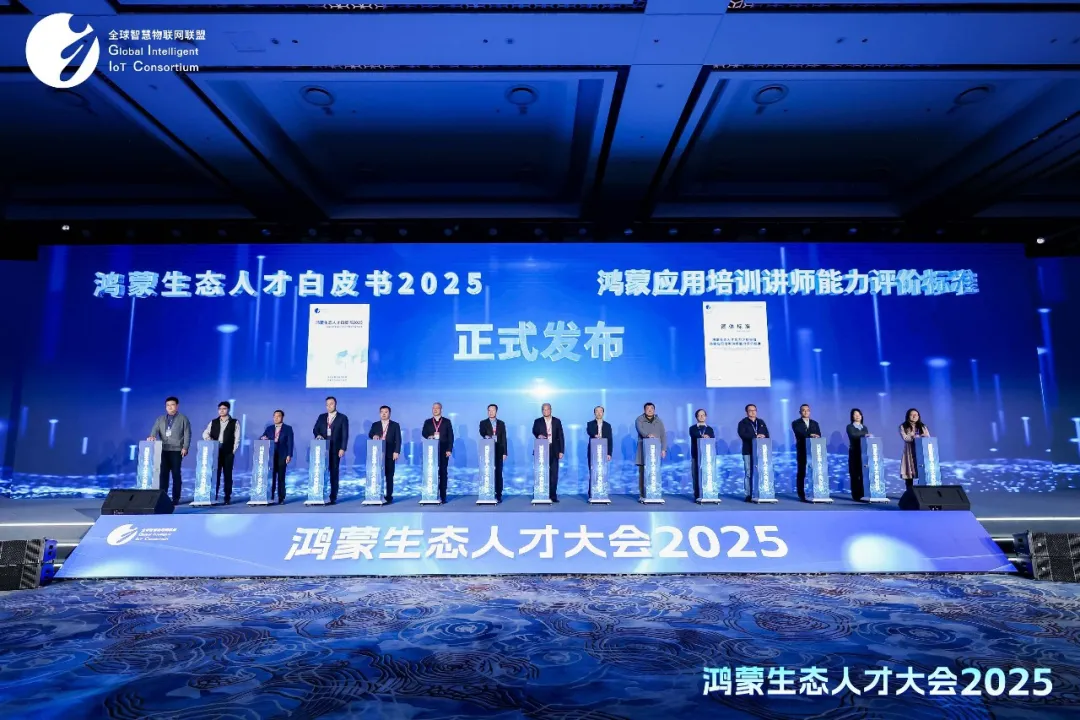
In the AIoT era, the OpenHarmony operating system, with its distributed architecture breaking device boundaries, has become the digital foundation for intelligent interconnection of all things, holding significant importance for the autonomous control of digital infrastructure. Currently, OpenHarmony has achieved leapfrog development with over 1.2 billion ecosystem devices and 10 million developers. At this juncture, talent has become the core variable for the OpenHarmony ecosystem's transition from "scale breakthrough" to "quality leap," and is the fundamental guarantee for resolving technical bottlenecks, activating industrial vitality, and building core competitiveness.
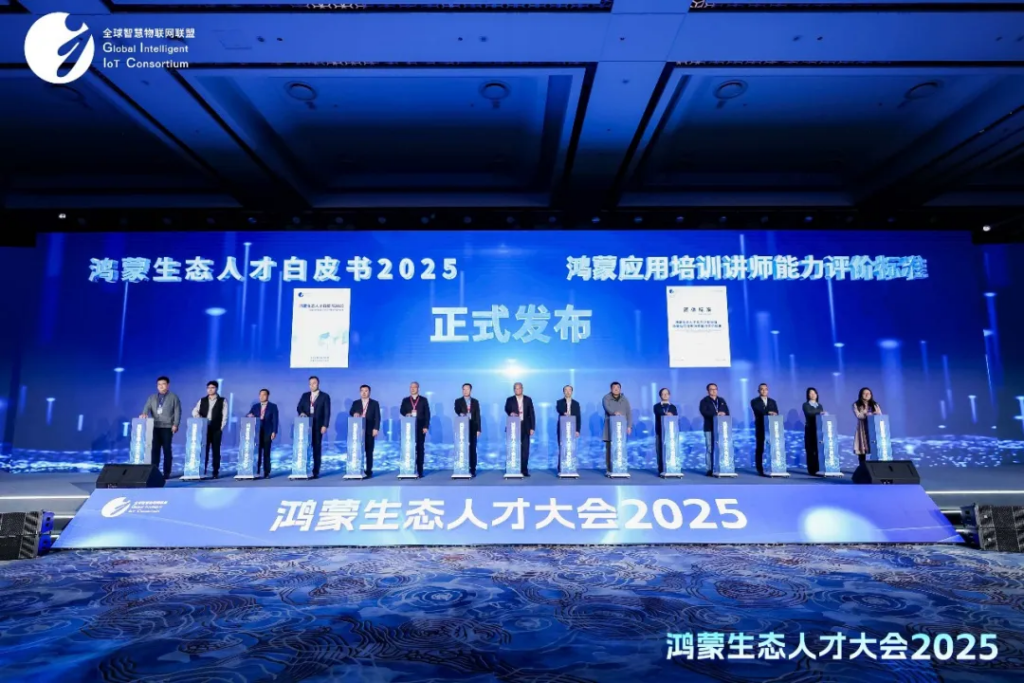
Recently, the Global Intelligent Internet of Things Consortium (GIIC) officially released the *HarmonyOS Ecosystem Talent White Paper 2025* [Follow the GIIC official WeChat account and reply "HarmonyOS Ecosystem Talent White Paper" to access the full report]. Jointly drafted by Huawei Technologies Co., Ltd., HarmonyOS Ecosystem Services (Shenzhen) Co., Ltd., Tsinghua University, Nanjing University, Wuhan University, Shenzhen University, Sichuan Normal University, and other institutions, this white paper aims to present a panoramic view of the supply-demand landscape, competency models, cultivation pathways, and development opportunities for HarmonyOS ecosystem talent. It serves as a strategic reference and action guide for government agencies, universities, enterprises, and developers.
The *HarmonyOS Ecosystem Talent White Paper 2025* provides a comprehensive analysis of the talent landscape within the HarmonyOS ecosystem, highlighting the current imbalance between talent supply and demand. According to the white paper, the ecosystem faces a talent gap of millions, which is expected to generate over 3 million new job opportunities in the future. These demands are primarily concentrated in Northbound application development and Southbound OpenHarmony device development, with 70% of the talent gap stemming from junior and senior development roles, followed by architects and testing professionals.
However, market talent supply has not kept pace with OpenHarmony ecosystem development, resulting in explosive overall demand exhibiting non-linear, exponential growth characteristics. This sharp supply-demand contradiction is directly reflected in the compensation market. Data shows that in 2024, the average salary increase for OpenHarmony developer positions reached 43.1%, with average monthly recruitment salaries approximately 22% higher than comparable technical positions. This significant "salary premium" phenomenon intuitively reflects the current high scarcity and market value of OpenHarmony talent.
In terms of geographic distribution of talent demand, it highly overlaps with China's overall digital economy landscape, with extremely significant agglomeration effects in core hubs. Talent demand is heavily concentrated in the three major regions: Beijing-Tianjin-Hebei, Yangtze River Delta, and Pearl River Delta. However, as local governments increasingly recognize the strategic value of the OpenHarmony ecosystem, talent demand has begun to spread to key second-tier cities with industrial foundations and transformation momentum. Yet, in this diffusion process, the structural mismatch between university talent cultivation layout and regional industrial demands has become increasingly prominent, emerging as a critical bottleneck constraining balanced ecosystem development.
The white paper also highlights the reconstruction of talent profiles, undergoing a profound transformation from relying on "single technology stacks" toward "composite full-stack" capabilities with cross-device, cross-layer, and cross-scenario problem-solving abilities. The job structure presents an "olive shape," with senior developers accounting for the highest proportion. Enterprises urgently need mid-to-high-end talent capable of independently tackling complex technical challenges and leading architectural design. In terms of skill requirements, 78% of enterprises require core developers to master at least two programming languages, with official certification systems becoming an important basis for talent screening. Meanwhile, developers need to address usability needs of special users and possess composite technical capabilities including audio-video codec, graphics rendering optimization, and lightweight AI model deployment. Talent cultivation must shift toward three-dimensional shaping of "technical depth + scenario breadth + user experience sensitivity."
Additionally, the white paper underscores the importance of policy-driven initiatives, with the policy focus shifting from "cultivating developers" to "managing intellectual capital." Inter-city development competition has also transitioned from industrial agglomeration to the construction of intellectual capital ecosystems. Cities such as Shenzhen, Chengdu, and Wuhan have established intellectual capital ecosystems through policies including talent certification subsidies, rewards for open-source contributions, and startup incubation programs, thereby forming differentiated ecological positioning. The agglomeration of intellectual capital is reshaping regional competitiveness, with local government support for industries, practical opportunities, and innovation atmosphere becoming key factors for developers when choosing where to develop their careers.
Faced with current market demands and characteristics, the OpenHarmony ecosystem talent cultivation model differs significantly from traditional technical talent cultivation.
On one hand, as the main front for talent cultivation, universities are undergoing systematic transformation from "introducing a new course" to "reconstructing curriculum systems and innovating education mechanisms." For example, Shanghai University of Engineering Science has explored a "dual-qualification" teaching model, constructing a spiral closed-loop cultivation ecosystem of "theoretical teaching – industrial practice – research feedback," enabling students to enhance practical capabilities through real-world projects.
另一方面,产教融合不断深化,企业对人才能力的评价标准从“是否持证”快速转向“能否实战”。领先的企业与高校合作开发基于真实商业需求的“微项目库”与“案例工坊”,让学生在校期间就能接触并解决具有复杂业务背景的工程问题,缩短毕业生从“知晓理论”到“创造价值”的适应周期。同时,针对B2B通用办公领域的鸿蒙化需求,人才培养还需依赖更深入的“行业导师制”与“企业真实项目浸入”,以满足企业级系统对人才的“技术 + 业务”复合型能力要求。
It is evident that HarmonyOS talent development is currently in a golden window defined by the triple forces of "strategic potential, market momentum, and value empowerment." Whether the ecosystem can fully and efficiently translate its immense technical potential and market prospects into sustainable industrial competitiveness and talent prosperity will directly depend on resolving three critical challenges: on the talent supply side, the "dual lag" in curriculum depth and instructors' practical capabilities; on the talent demand side, the disconnect between enterprises' requirements for "immediate combat readiness" and universities' "disciplinary" cultivation approaches; and at the ecosystem collaboration layer, the "breakpoints" and "time lags" among industry, academia, research, and application.
鸿蒙生态的建设,本质上是一场围绕数字主权与产业未来的集体远征。其成功不仅需要技术的突破,更需要人才的集群式崛起。政府、企业、高校与每一位开发者,都是这场远征中不可或缺的参与者。唯有各方秉持长期主义的信念,在战略上协同,在机制上创新,在行动上务实,共同构建起一个“政府引导、企业主体、高校支撑、开发者共创”的健康人才生态,方能将当下的历史性机遇,转化为中国在万物智联时代的持久竞争力。